
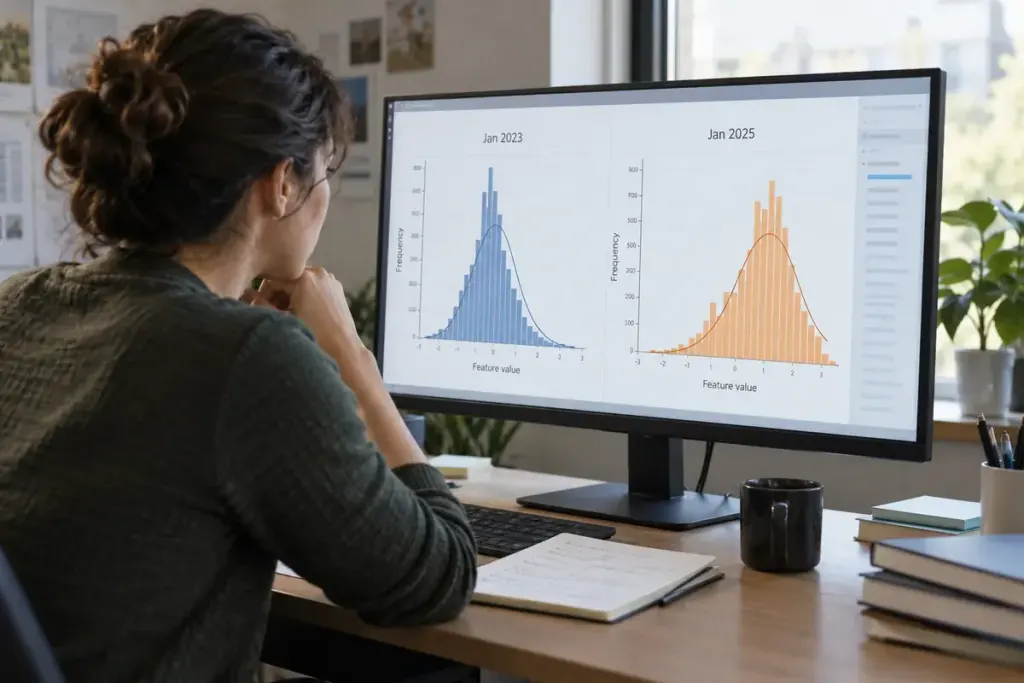
An AI model can keep the same version number while the world around it changes. New customers, different document formats or a revised data pipeline can alter the inputs it receives. Monitoring only deployments would miss those changes.
Data drift describes a change in the distribution of data compared with a chosen reference. Google Cloud’s monitoring documentation gives examples of comparing recent production data with training data or an earlier production period. The comparison is meaningful only when the reference and measurement are clear.
An alert is a question to investigate
A drift alert does not automatically prove that predictions are wrong. A seasonal change may be expected and handled adequately. Conversely, stable-looking input distributions do not guarantee good performance on every subgroup or unusual case.
Consider an invented support-ticket classifier. A new product introduces vocabulary the training data rarely contained. The team sees a change in word patterns. To judge the impact, it still needs reviewed examples and an appropriate performance measure, rather than assuming the distribution change itself establishes failure.
Check the pipeline before retraining
Confirm that field names, units, missing-value handling and timestamps have not changed unexpectedly. A broken input conversion calls for a pipeline repair; retraining on corrupted data can preserve the problem.
Next examine representative cases from the affected period, including meaningful subgroups. Compare predictions with reliable outcomes where available, and record delays when the true outcome will not be known immediately. Keep access to sensitive examples limited to authorised reviewers.
Assign an owner and a response path to each alert. Decide when to investigate, restrict a workflow or fall back to human review based on the application’s consequences. A dashboard that changes colour without a decision process is only a display.
Keep the model version, input baseline and evaluation date together. That record helps explain whether a later improvement came from correcting the data, changing the model or simply observing a different period.