
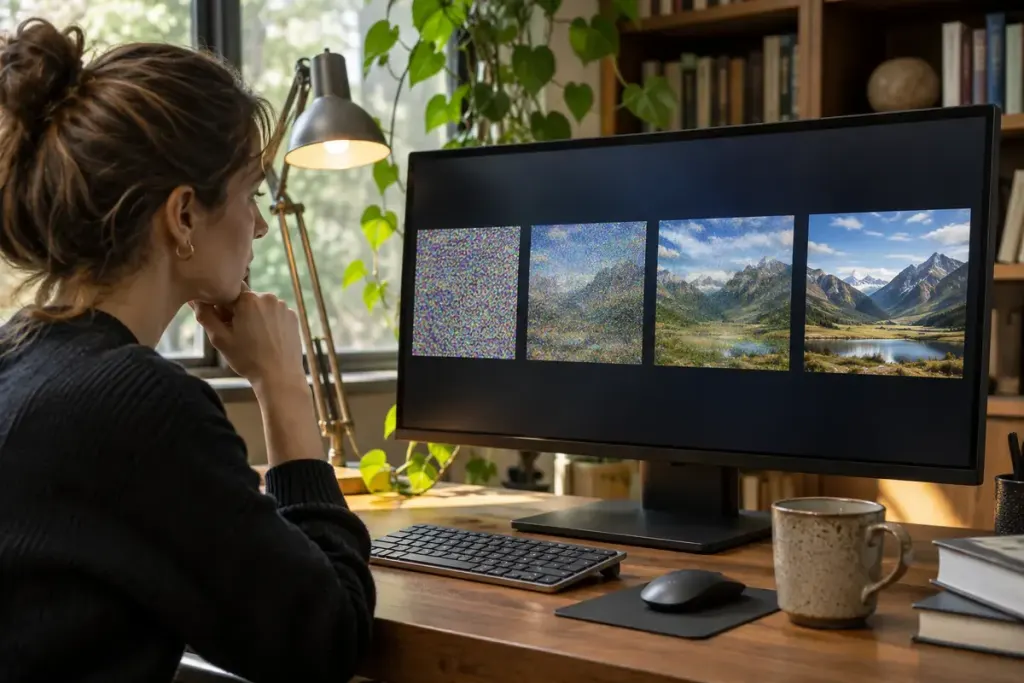
A diffusion image model can begin with noise and gradually produce a recognisable scene. It is tempting to imagine a finished photograph hidden beneath the static. The more useful explanation is that the system has learned statistical ways to reverse a noising process, guided by its training and any conditioning supplied.
The research paper Denoising Diffusion Probabilistic Models by Jonathan Ho, Ajay Jain and Pieter Abbeel describes a foundational version of this approach. During training, noise is added to data in controlled stages; a model learns a reverse process. Generation then uses learned steps to move from a noisy state toward a sample.
Separate the mechanism from the metaphor
“Removing noise” is a useful shorthand, but it can suggest that the correct answer already exists inside the starting image. In unconstrained generation, there is no single original photograph that must be recovered. Different random starting conditions and settings can produce different outputs.
Text conditioning can influence what is generated, but it does not turn the model into a factual camera. A plausible laboratory, machine or street scene may contain incorrect details. Visual coherence is not evidence that the depicted event occurred or that the object would work.
Use a controlled comparison
For an illustrative experiment, keep the prompt and settings fixed while changing only the random seed, if the tool exposes one. Compare composition, object count and small structural details. Then keep the seed fixed and change one instruction. Record the model and settings so you know what the comparison actually tested.
That exercise can show sensitivity to inputs; it does not measure every aspect of the model’s quality. It also does not establish that the system never memorises training examples. Questions about memorisation, provenance and rights require their own evidence and checks.
Not every contemporary image generator uses exactly the same architecture or sampling method as the 2020 paper. Treat diffusion as a family of methods, and read the documentation for the actual tool. The underlying lesson remains useful: a generated image is a model-produced sample to inspect, not a recovered photograph to trust automatically.